Bradenton Tree Removal handles tree trimming and pruning for properties across Bradenton, FL, serving surrounding cities including Samoset, Palmetto, Bayshore Gardens, Ellenton and Memphis. Twenty-plus years on this coast is the difference between a crew that cuts to a shape and one that cuts to an objective — and between a crew that knows a laurel oak ages into decay faster than the live oak beside it and one that treats them as the same tree.
Every cut we make answers to the ANSI A300 pruning standards, which exist precisely because the popular alternatives are so damaging. Topping and hat racking are the two we get asked for most, and the answer is the same for both, on any tree, at any price.
We also price trimming with the disposal separated out, which matters more on pruning work than on removals. A crown cleaning on a large oak can produce more material than people imagine, and there is no firewood market in this climate to absorb it. Seeing that line before you agree is how you tell a fair trimming quote from a cheap one.
Pruning to a Standard, Not to a Shape
Crown Cleaning, Thinning, Raising and Reduction
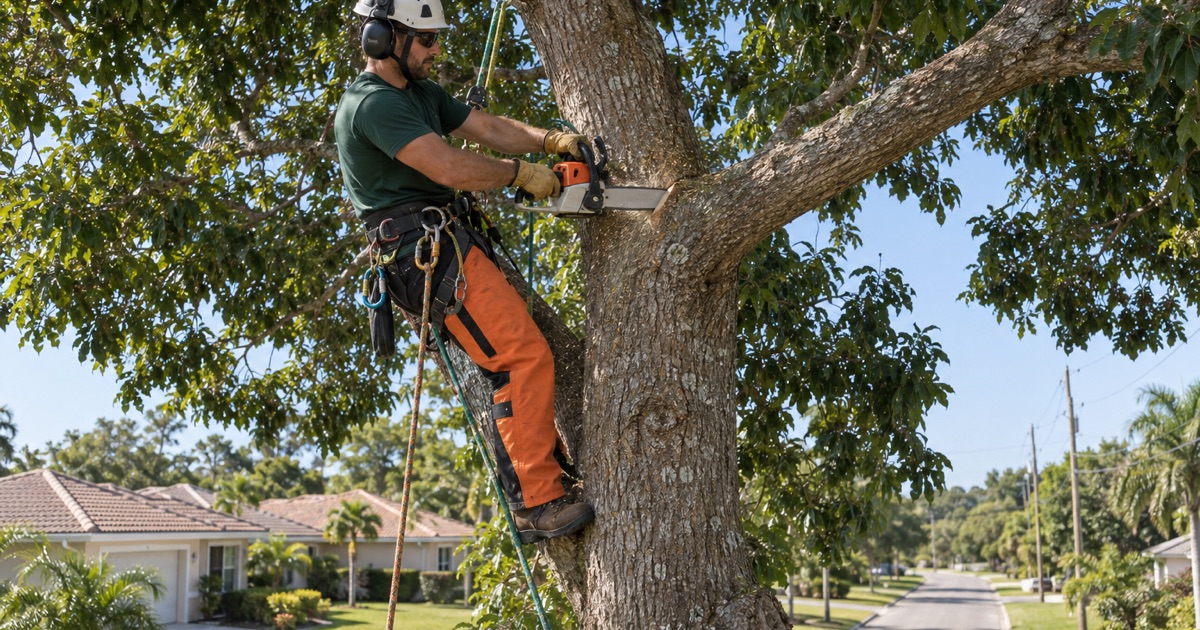
The four objectives cover almost everything a mature tree actually needs. Cleaning takes out dead, diseased, broken and detached wood and is the highest-value work on most established trees here. Thinning selectively reduces density so air moves through a canopy, and raising lifts the lower limbs off a roof, a walk or a driveway. Reduction shortens specific leaders to a lateral large enough to take over, which is a real technique and is not topping.
Directional Pruning Away From Structures
Where a canopy leans over a roof, a pool cage, a lanai or a service drop, the useful answer is to change where the tree puts its next decade of growth rather than to keep cutting the same limbs back. Directional pruning removes growth on one side back to laterals oriented away from the target, so the tree’s own response works with the clearance instead of against it. It takes more thought per cut and far fewer visits over time.
Why We Will Not Top or Hat Rack a Tree
Topping cuts leaders back to stubs with no lateral able to assume the terminal role. The tree responds from dormant buds with a dense flush of shoots attached only to the outer wood, and those shoots are structurally weaker than what was removed while the stub itself decays inward. Three years later the tree is taller, denser and genuinely more dangerous, and the wound is permanent. We turn the work down and explain the alternative.
Trimming by Species on This Coast
Live Oak, Laurel Oak and the Difference Between Them
These two dominate the mature canopy here and they are not interchangeable. Live oak is dense, long-lived and tolerant of a well-executed cleaning cycle. Laurel oak grows faster, decays earlier and frequently forms co-dominant stems with included bark, so on laurel oak the pruning conversation turns into a structural one sooner. Spanish moss and ball moss in either canopy are epiphytes rather than parasites, and removing them is a preference, not a treatment.
Pines, Gumbo Limbo, Sea Grape and Coastal Species
Slash pine tolerates deadwood removal and resents heavy live pruning, and a pine that has lost its neighbors to a lot clearing is a wind exposure question rather than a pruning one. Gumbo limbo and sea grape take shaping well. One caution on coastal frontage: dune plantings seaward of the Coastal Construction Control Line are protected under state rules with their own maintenance guidelines, so trimming there is not the same job as trimming the same species in a front yard.
Sabal Palms and the Nine and Three Line
Palm work runs alongside our trimming service and follows its own rules. Fronds below the horizontal come off; living green fronds above it stay. A sabal palm’s costapalmate fronds and persistent boot skirt make an over-trimmed specimen obvious from the street, and repeated over-pruning produces the permanent narrowing called pencil-pointing. On a self-cleaning palm with a crownshaft, much of what people pay to have cut would have dropped by itself.
Timing, Storm Season and Utility Clearance
Pre-Season Pruning and Deadwood Removal
The work that actually reduces storm risk is unglamorous: dead and hanging wood out, broken stubs cleaned up, crossing limbs resolved, clearance restored over the roof, and any structural defect either addressed or documented. Done in the spring it is scheduled work at scheduled prices. Attempted in September it competes with every emergency in four counties, and the city’s own guidance says not to start it once a storm is approaching.
Pruning Cycles Rather Than Reactions
A property on a cycle costs less over ten years than the same property pruned whenever something alarms somebody. Each visit is smaller, the tree never takes a heavy reduction, and the defects get caught while they are cheap. We leave a suggested return interval per tree in the written findings, which associations and property managers can turn into a budget line rather than an annual argument.
Working Near Energized Conductors
ANSI Z133 governs safety in arboricultural operations, and its electrical sections restrict who may approach an energized conductor and how close. It also prohibits working near energized conductors in high winds and during storms — a limit the 2026 edition carried forward, alongside a new section covering palm operations for the first time. Line clearance belongs to the utility; we work outside those distances and tell you who to call for the rest.
Commercial, Association and Managed Property
Common Areas, Districts and Boards
Common-area trimming for associations and community development districts is inventory work before it is cutting work. Boards need to know how many trees, in what condition, at what cost, over how many years. We map and prioritize rather than quoting a lump sum for the whole property, which lets a district phase the spend and lets a manager show where the money went.
Commercial Sites, Parking Rows and Sight Lines
On commercial property the driver is usually clearance and liability rather than appearance: canopy off the building line, limbs above truck height on delivery routes, sight lines clear at exits, lighting and signage unobstructed, and no dead wood above a pedestrian area. Those are inspectable conditions, and documenting the date each was addressed is worth as much to a risk manager as the cutting itself.
Written Findings for People Who Were Not There
Every managed-property visit leaves a record: what was pruned, what was found and not pruned, what should be looked at again and when. Seasonal owners, home watch services and off-site managers get the same photographs and notes. The point is that a decision made in a yard in May is still legible to somebody reading it in an office in November.
- 20+ Years on This Coast
- Written Estimates
- No Topping, No Hat Racking