Permit-Free Tree Removal Under Section 163.045
Florida Statutes section 163.045 bars a local government from requiring a notice, application, approval, permit, fee or mitigation to prune, trim or remove a tree on residential property when the owner possesses signed documentation that the tree poses an unacceptable risk. The documentation must be an onsite assessment performed under the ISA Best Management Practices Tree Risk Assessment, Second Edition 2017, by an ISA-certified arborist or a Florida licensed landscape architect. Getting that document is the job, not the paperwork after it.
The Unacceptable Risk Standard, Not Dangerous
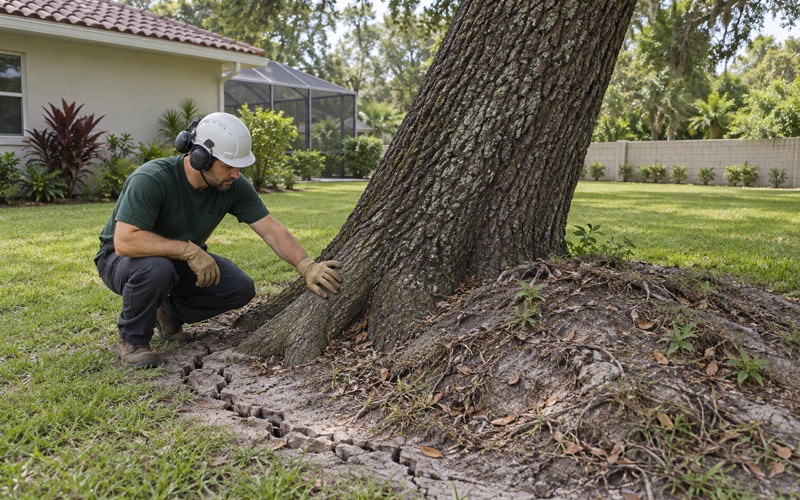
The statutory test is unacceptable risk, which is a defined outcome of a formal risk assessment weighing likelihood of failure, likelihood of impacting a target, and consequences. It is not a subjective judgment that a tree looks dangerous, and it is not satisfied by a photograph or a phone opinion. That is why the assessment is a site visit with measurements and a signed document, and why a company that offers to skip it is offering you an exposure rather than a shortcut.
Where the State Preemption Stops
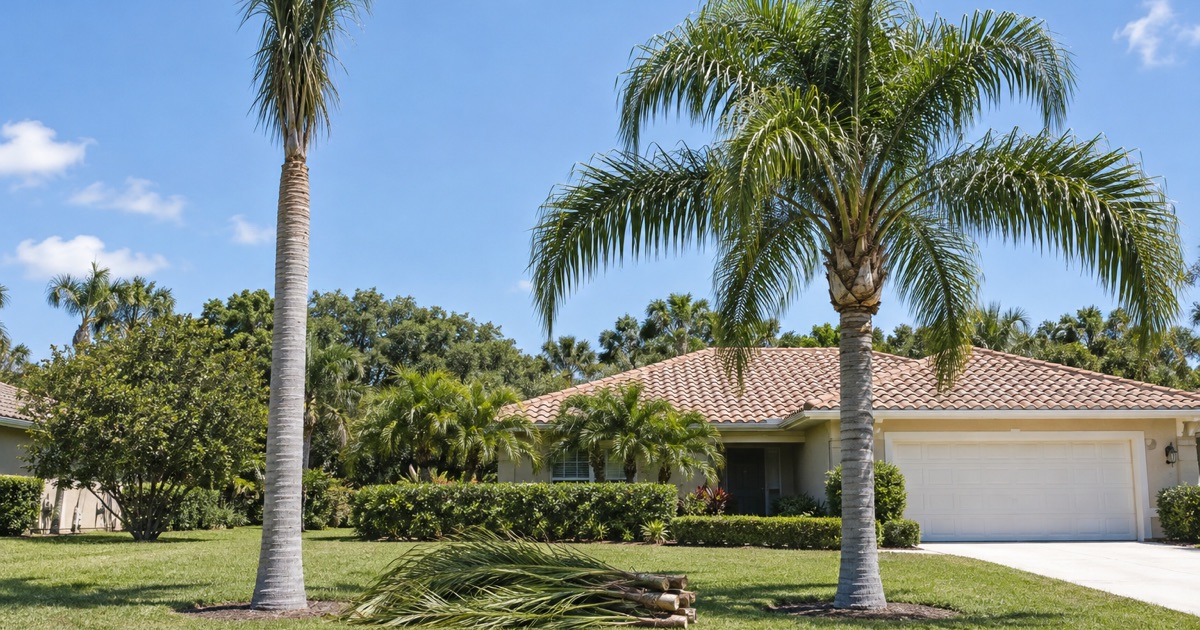
The statute defines residential property as a single-family, detached building on a lot actively used for single-family residential purposes. That is a narrow definition, and a great deal of housing in this market falls outside it. A duplex, a townhome, a condominium parcel, a mobile or manufactured home, a vacant lot and any commercial or industrial property are all outside the preemption, and the local permit applies to them in full.
Condo, Townhome and Vacant-Lot Tree Removal
For the property the statute does not reach, the local code governs and the process is a real permit with real timelines. Inside the City of Bradenton that means the city’s own protected-tree rules, which classify by diameter at breast height and attach replacement obligations that scale sharply with size. Associations, community development districts and property managers get the permit pathway priced in the estimate, because the approval is often the longest part of the schedule.
County and City Tree Rules Across the Ring
Working across Manatee, Sarasota, Pinellas and Hillsborough means four different answers, and your city may differ from your county again on top of that. Hillsborough County’s residential tree guide applies only to unincorporated addresses and runs a grand oak point system; Sarasota County codifies its own exemptions; several Pinellas municipalities operate town-level tree applications of their own. The first thing we establish on any quote is which authority your parcel actually answers to.
Mangrove Trimming Sits Outside the Preemption
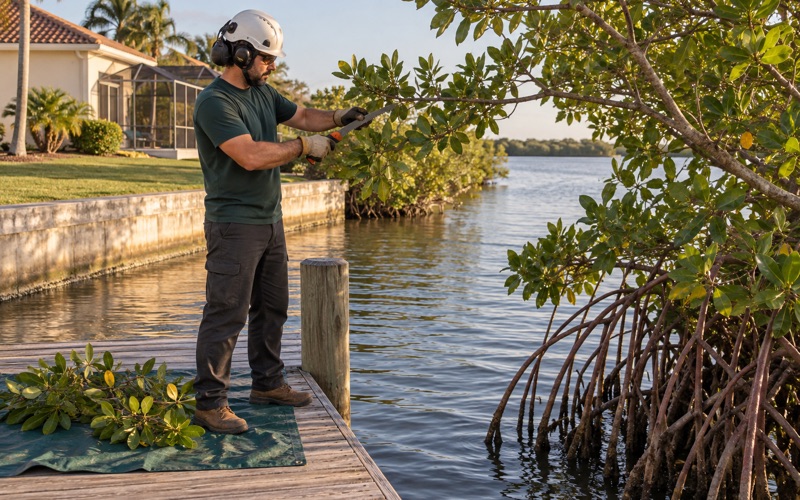
Mangroves are carved out of section 163.045 by name, and are governed instead by the 1996 Mangrove Trimming and Preservation Act. Manatee County’s own environmental planning staff state that the county has not been granted delegated authority from the Florida Department of Environmental Protection, so mangrove work here goes to the state while the same job in Hillsborough goes to the Environmental Protection Commission and in Pinellas to the county, reaching inside its incorporated cities.
Overhanging Limbs and Neighboring Trees
A neighbor’s limbs over your roof are generally yours to cut back to the property line at your own cost, and cutting past that line or damaging the tree changes who is liable. A healthy tree that fails in a storm and lands on your house is usually your insurer’s problem rather than your neighbor’s; a tree already documented as hazardous is a different conversation. We put the condition and the date in writing, which is what makes that conversation possible later.
Written Tree Condition Reports
A written condition report records species, diameter at breast height, observed defects, the target beneath the tree, and the recommendation with its reasoning. It is what the insurer, the association or the buyer’s inspector reads a year later when nobody remembers the site visit. Seasonal and second-home owners get findings and photographs the same way, so an inspection still means something when nobody is standing in the yard.
Cabling and Bracing as an Alternative to Removal
A co-dominant union with included bark is a structural defect that a supplementary support system can manage for years, and taking down a mature shade tree that could have been cabled is a permanent answer to a solvable problem. Installed and inspected to ANSI A300 Part 3, cabling and bracing buys time on a tree worth keeping. We will tell you when it is the honest recommendation, including when it costs us the removal.