Bradenton Tree Removal provides tree disease treatment and plant health care for properties across Bradenton, and the first thing worth saying about this service is that a fair share of our diagnoses end in no treatment at all. Twenty-plus years on this coast is largely twenty years of learning which declines are a pathogen, which are a site problem wearing a pathogen’s symptoms, and which are simply over.
That matters commercially as well as horticulturally. Two of the conditions that most often kill palms in this region have no treatment whatsoever, and both are routinely sold treatment programs by somebody. A diagnosis that ends in an honest no costs a customer far less than a program that ends in a removal two years later.
Diagnosis Before Anything Else
Reading the Site, Not Just the Symptom
A good diagnosis starts with the pattern. Which plants are affected and which are not, whether the decline runs along a drainage line or a construction edge, what order the parts of the plant failed in, and what changed on the property in the last few years. Symptoms converge — a great many problems produce a thinning canopy — so the distinguishing information is almost always in the site rather than in the leaf.
The Root Collar and the Soil
We expose and inspect the root collar on any declining mature tree, because a buried collar hides decay, girdling roots and stem rot, and burying one is easy to do with a few years of added mulch or a load of construction fill. Alongside it we look at compaction, drainage and how the seasonal water table behaves on that part of the property, since roots suffocating in saturated ground look very much like disease.
When the Answer Is That There Is No Treatment
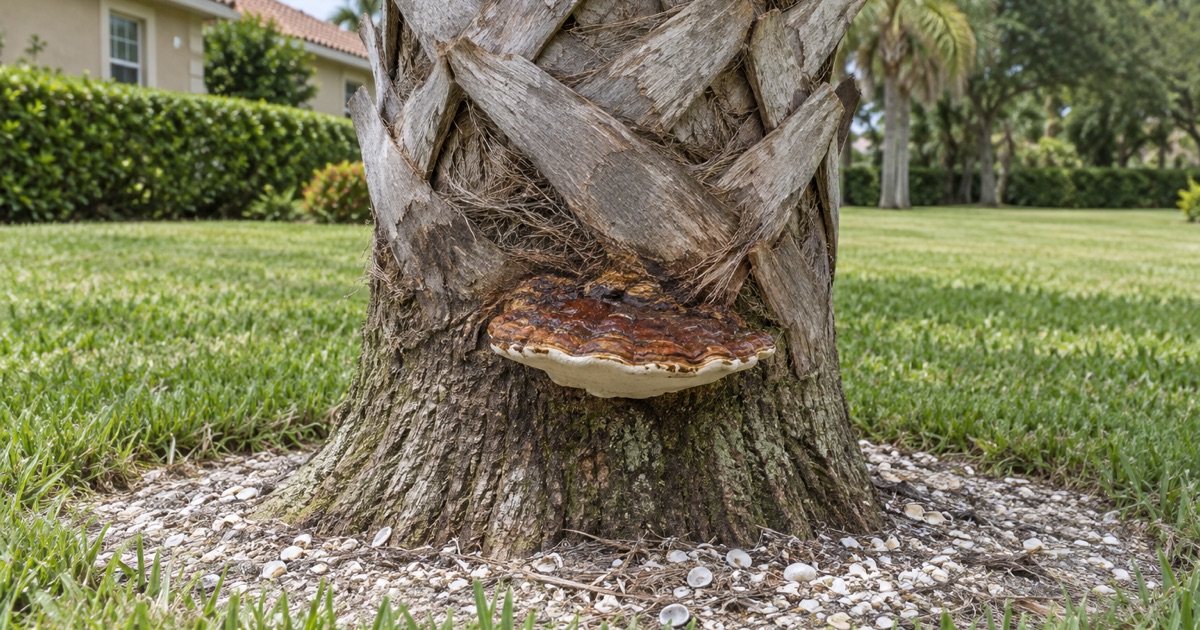
Some findings end the conversation. Ganoderma butt rot in a palm, advanced internal decay in a structural stem, a girdling root that has already strangled most of the vascular tissue — these are managed or removed, not cured. Saying so plainly is the point of paying for a diagnosis, and it is the part of this service most often skipped by companies whose diagnosis exists to sell a program.
Palms: Disorders and Diseases
Nutrient Deficiency Is the Common One
The sandy soils here leach readily, and potassium deficiency is the single most frequent palm problem we see. It shows as translucent yellow-orange spotting and necrotic tips on the oldest fronds, and it is made worse by removing those fronds, because the palm is drawing potassium out of them as it goes. The fix is a palm-appropriate fertilization program applied on a schedule, plus leaving the affected fronds in place while it works.
Ganoderma and Lethal Bronzing
These are the two that end palms. Ganoderma zonatum affects palms and no other plant family and announces itself with a conk at the base only after the lower trunk is already degraded. Lethal bronzing is a phytoplasma spread by a planthopper, and it usually shows first in premature fruit drop and blackened flower stalks rather than in the canopy. Neither is curable once a palm is symptomatic.
Trunk Rots and Sudden Structural Failure
Thielaviopsis trunk rot deserves separate attention because it gives so little warning. It degrades trunk tissue internally, sometimes with a dark stain or an ooze at the surface, and a palm can lose its crown or snap at the affected section while the canopy still looks healthy. Where the signs are present, the palm is treated as a structural hazard rather than a horticultural case.
Hardwoods, Decay and Mistaken Culprits
Decay Fungi and What They Actually Mean
A fruiting body on a trunk or a buttress is a report on what is happening inside, and the useful question is how much sound wood remains around the decay rather than what the mushroom looks like. Where decay sits in a structural stem above a target, the response is a risk assessment and a structural decision. Where it is in a stub or dead outer bark, it may mean very little at all.
Epiphytes, Vines and Passengers
Spanish moss and ball moss take nothing from the tree they sit on, and heavy growth of either is usually a consequence of a thinning canopy rather than its cause. Vines are a different matter, since a heavy vine load adds wind area and weight and can shade out a canopy over time. We separate the passengers from the problems rather than charging to remove whatever is most visible.
Construction, Fill and Salt
Much of what presents as disease on established trees here traces back to something mechanical. Fill placed over a root plate, a trench cut for a utility or a pool, compaction from equipment, a changed drainage pattern, or salt in the root zone after a surge event all produce slow decline on a delay of one to three years. By then nobody connects the two, which is exactly why the site history is part of the diagnosis.
- 20+ Years on This Coast
- Written Estimates
- No Topping, No Hat Racking