
Bradenton Tree Removal takes on land clearing and lot clearing throughout Bradenton, FL, serving surrounding cities including Samoset, Palmetto, Bayshore Gardens, Ellenton and Memphis. Clearing is where local rules bite hardest and where an out-of-area contractor is most likely to be wrong, because the parcel usually sits outside every exemption a homeowner has heard of and the permitting is the long pole in the schedule.
The order of operations on a clearing job is what separates a clean one from an expensive one. Establish the jurisdiction, identify the protected trees, fence what stays, then move equipment. Doing it the other way round produces a violation notice, a mitigation bill, or a preserved specimen that quietly dies two seasons later.
We price the clearing and the disposal separately, as we do on every job on this site. On a clearing job that split matters more than usual: the felling is often the smaller number, and what it costs to get the material off the parcel is where a low headline price gets made back.
Clearing Scopes and What Each One Means
Full Clearing to a Building Pad
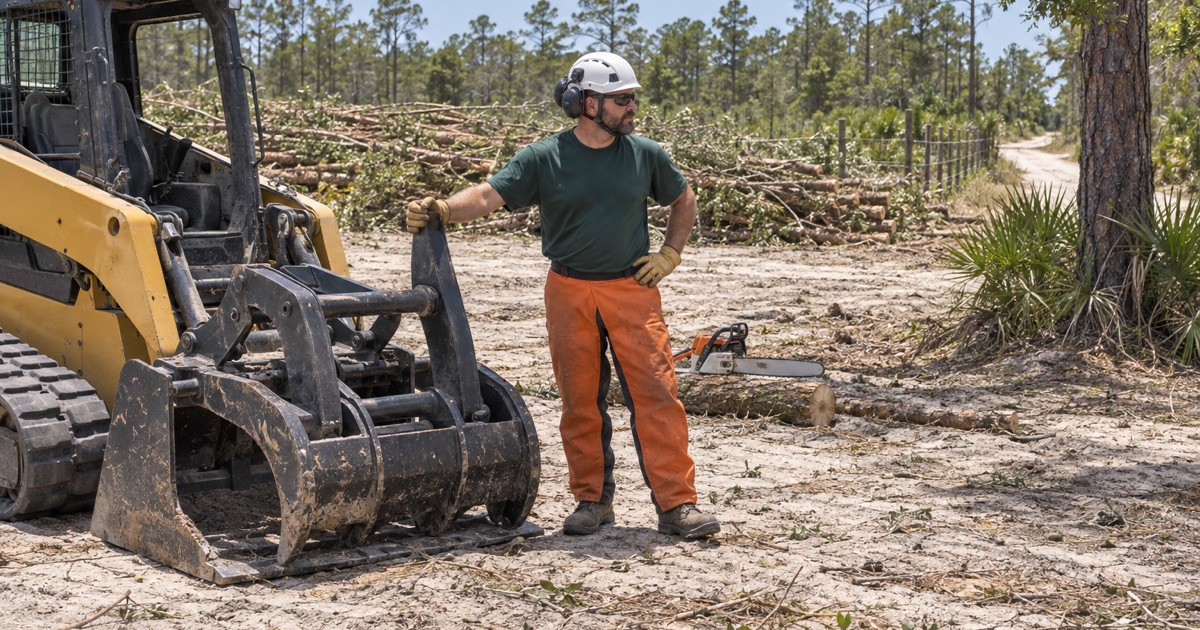
A pad for construction means everything down and out: canopy felled and removed, understory cleared, stumps grubbed or ground below the bearing zone, and the surface left workable for a surveyor and a foundation crew. This is the scope with the most disposal weight attached and the most permitting behind it, and it is worth confirming what the site plan actually requires before assuming the whole parcel needs it.
Selective and Understory Clearing
Most residential and acreage clearing is not a pad. It is opening up an overgrown parcel while keeping the mature canopy that gives it value: brush and small stems out, deadfall removed, sight lines opened, specimen trees retained and released from competition. Selective clearing costs less, permits more easily, and leaves shade that takes forty years to replace. Where it is the right answer, we say so before quoting a full clear.
Fence Lines, Easements and Access Roads
Linear clearing is its own kind of work: a fence run to be cleared to a working width, a utility or drainage easement to be reopened, a track cut to give equipment access to the back of a parcel. These jobs are usually mulched in place because there is nowhere to stage material and no reason to haul it, and they are frequently the first thing a larger clearing job needs before anything else can start.
Forestry Mulching, Chipping and Hauling
Mulching in Place Versus Grubbing and Hauling
Mulching processes standing material where it stands and leaves it as a ground layer, which suppresses regrowth and costs nothing to dispose of. Grubbing takes root balls out and produces a load that has to go somewhere. The choice is driven by what happens to the ground next: a pasture, a fence line or a released stand suits mulch, while anything with a footing, a slab or a drainage structure in its future does not.
Keeping the Waste Streams Separate
A clearing site generates clean vegetative material, and it often generates old fencing, buried concrete, roofing scraps and other debris from whatever was on the parcel before. Those are charged differently at the gate, and mixing them means paying the higher rate on the whole load — mixed and uncovered loads carry their own penalty on top. Separating on site is the cheapest hour anyone spends on a clearing job.
Chip Piles, Mulch Stockpiles and What Stays
Owners frequently want a share of the material back: a mulch stockpile for beds, chip cover on a track, or hardwood rounds set aside. All of that reduces the hauled weight and therefore the disposal line, and all of it needs deciding before the machines start rather than after the trucks have gone. Where a temporary stockpile has to sit for a while, we place it clear of drainage and clear of preserved root plates.
Permits, Protected Trees and Mitigation
A Vacant Lot Sits Outside the State Preemption
Florida Statutes section 163.045 reaches only a single-family detached building on a lot actively used for single-family residential purposes. A vacant lot, a parcel awaiting construction, agricultural land and commercial ground are all outside it, and no arborist documentation changes that. Clearing work is therefore permit work almost by definition, and the first thing we establish is which city or county code the parcel actually answers to.
Protected Trees, Grand Trees and Replacement
Inside the City of Bradenton a protected tree is defined by diameter at breast height and by species maturity, with size classes running from non-significant up to grand at just over 30 inches, and the replacement obligation climbs steeply with the class — a grand tree carries ten replacements, against far fewer for smaller classes, with an in-lieu payment into the city tree fund as an alternative. Clear-cutting a larger property carries its own per-acre penalty. Those numbers belong in the project budget from the start.
Wetlands, Water Management and Shoreline
Tree rules are not the only jurisdiction on a parcel. Wetland and surface water work in this region falls to the Southwest Florida Water Management District, shoreline work carries its own conditions, and mangroves sit under the Mangrove Trimming and Preservation Act entirely outside any tree ordinance. Because Manatee County holds no delegated mangrove authority, a parcel with mangrove frontage here routes to the state rather than to the county.
Protecting What Stays
Tree Protection Zones, Established First
Every preserved tree on a clearing site gets a fenced protection zone sized to its root plate, and the fence goes up before the first machine moves. Inside that line there is no traffic, no stockpiling, no material storage and no washout. This is the cheapest insurance on the job and the most commonly skipped, because nothing appears to go wrong when it is left out.
Compaction Is the Damage Nobody Sees
Equipment traffic over a root plate compacts the soil column and cuts off the air and water exchange fine roots depend on, and in these poorly drained flatwoods soils the margin is thin to begin with. The tree does not decline that month; it declines two summers later, when the connection is no longer obvious. Where compaction has already happened, decompaction and root collar excavation with an air spade can recover some of it.
Invasive Removal Written Into the Approval
On many sites here, taking out named exotics is a condition rather than a choice. Brazilian pepper, Australian pine, melaleuca and earleaf acacia appear on the lists that development approvals and local codes point at, and the requirement is usually removal plus a treatment schedule, since cut stumps of several of these resprout vigorously. We handle that as documented compliance work, with the treatment dates recorded alongside the clearing.
- 20+ Years on This Coast
- Written Estimates
- No Topping, No Hat Racking