Bradenton Tree Removal handles palm tree trimming and palm removal across Bradenton, FL, serving surrounding cities including Samoset, Palmetto, Bayshore Gardens, Ellenton and Memphis. Palms are quoted and crewed separately here for one reason: a palm is not a tree in any structural sense, and almost every habit carried over from hardwood work damages it.
Our crews prune to the nine and three clock line and stop there. That is not a house style, it is what the organism can survive without spending reserves it cannot replace, and it is the single biggest difference between a palm that still looks like itself in ten years and one that does not.
The other half of palm work is diagnosis. Two of the diseases that end a palm in this region are untreatable and one of them is contagious to neighboring palms, so the difference between a fertilization problem and a death sentence is worth getting right before anybody quotes a removal or sells a treatment program.
Trimming a Palm on Its Own Terms
One Growing Point, No Branch Collar
A palm is a monocot. It has a single terminal bud, no cambium, no branch collar to prune back to, no capacity to compartmentalize a wound and no way to add girth to a trunk section once it is formed. Damage the bud and the palm dies; there is no second leader waiting to take over. Everything below follows from those facts rather than from preference.
The Nine and Three Clock Line
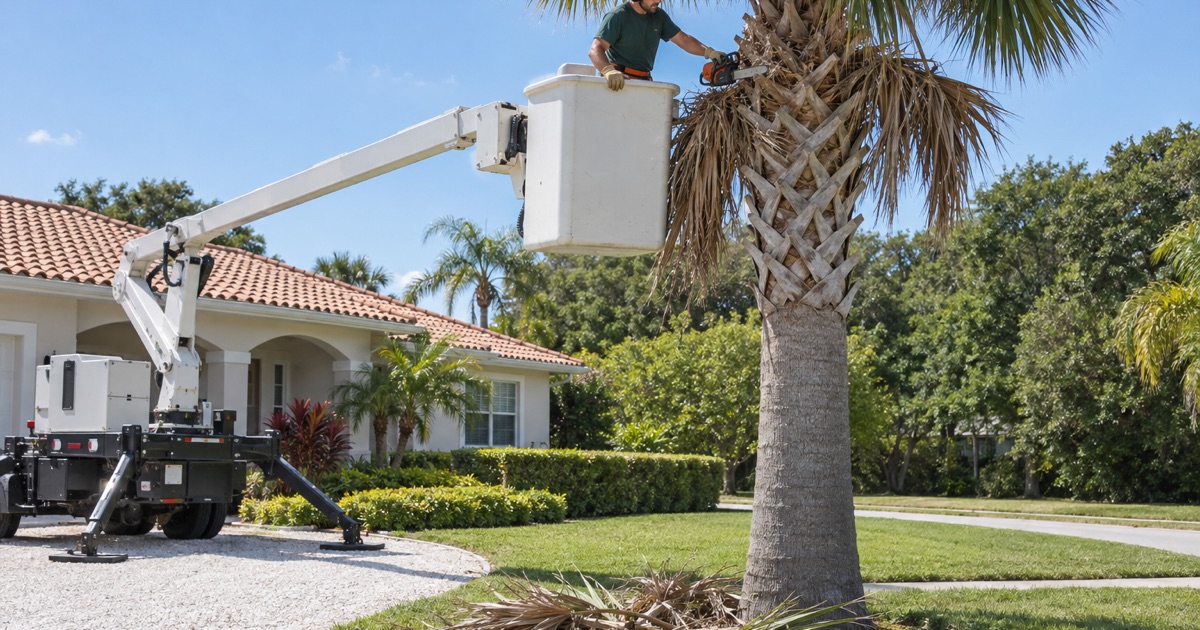
Picture the crown as a clock face seen from the side. Fronds hanging below the nine and three horizontal are spent and come off. Living green fronds above that line stay, because they are still feeding the palm and holding nutrient reserves it draws on through the year. Cutting above the line takes food and stored potassium out of an organism that has no way to replace either quickly.
Self-Cleaning Palms, Crownshafts and Frond Skirts
Some palms do the job themselves. A royal palm carries a smooth green crownshaft and sheds its own fronds cleanly, which means most trimming on one is really about controlling where a heavy frond lands rather than about the palm’s health. Others hold a persistent skirt of dead fronds, which is a shelter and a fuel question as much as an appearance one. We say which category yours is in before quoting a cycle.
Over-Pruning and the Damage That Does Not Reverse
Hurricane Cuts and Hat Racking
The hurricane cut on a palm and hat racking on a hardwood are the same mistake in two forms: remove most of the crown, and the plant spends stored energy rebuilding what it did not need to lose. On a palm the consequence is sharper because there is nowhere else for the energy to come from. We do not perform either, on any tree or any palm, and we say so at the estimate rather than after.
Pencil-Pointing and Permanent Taper
A palm that is repeatedly over-pruned lays down progressively narrower trunk tissue at the top, producing the visible taper called pencil-pointing. Because a palm cannot thicken a section it has already built, that narrowing is permanent, and the narrowed section is the weak point when a real wind arrives. The cut sold as storm preparation is what eventually snaps the palm, several years after whoever sold it has moved on.
Potassium Deficiency in Sandy Soils
The soils across this area are sandy and leach nutrients readily, and potassium deficiency is correspondingly common. It appears as translucent yellow-orange spotting and necrotic tips on the oldest fronds, and it is made worse by removing those fronds, because the palm was in the process of translocating potassium out of them. Cutting the symptom accelerates the disease. The answer is a palm-appropriate fertilization program and patience.
Diagnosis: What Is Treatable and What Is Not
Ganoderma Butt Rot
Ganoderma zonatum affects palms and no other plant family, and it hollows out the lower trunk from within before anything shows above ground. The conk is the diagnostic sign, and it is a late one. There is no treatment, no resistant species and no soil fumigation that reliably clears the site, so a confirmed palm comes down and the stump and root mass come out with it rather than being left as an inoculum source.
Lethal Bronzing and Spear Leaf Collapse
Lethal bronzing runs a recognizable sequence: premature fruit drop and blackened flower stalks first, then bronzing of the oldest lowest fronds working upward, then collapse of the unopened spear leaf, then death. Its host list includes cabbage palm, queen palm and coconut among many others, and the months-long latent period means neighbors are frequently already infected. Confirmed palms are removed promptly to reduce the source of infection nearby.
Thielaviopsis Trunk Rot and Sudden Failure
Thielaviopsis trunk rot deserves separate mention because it is the one that gives least warning. It softens trunk tissue internally, sometimes with a dark stain or an ooze at the surface, and a palm can snap at the rotted section or lose its entire crown with a canopy that still looked green the week before. Where we see the signs, the palm is treated as an immediate hazard rather than something to watch.
Removal, Access and What Comes Out of the Ground
Sectioning, Rigging and Crane Picks
A palm trunk is dense and heavy for its diameter, and a skirt of dead fronds adds weight and wind area exactly where it is least helpful. Most palm removals near a structure come down in sections, lowered on rope rather than dropped. Where the palm sits inside a screen enclosure, over a pool, or in a courtyard with no rigging point, a crane pick is the right answer and we price it as one.
Species Sets the Price Class
The four you meet most here behave differently on a job. Sabal palmetto carries costapalmate fronds and often a boot skirt that has to be dealt with before anything else. Queen palm drops heavy fruit and is comparatively soft, while royal palm is self-cleaning but sheds fronds that weigh enough to matter below. Mexican fan runs tall and thin with a hanging skirt, which makes access and drop zone the whole conversation.
Stumps, Arisings and Disposal Weight
A palm stump has no taproot but a dense fibrous mat, and in wet ground it holds water and grinds heavy. That shows up in the disposal weight rather than in the felling time, which is why it appears as its own line on our estimates. Where the palm came out for Ganoderma, grinding the stump and root mass is part of the job, not an upsell offered afterwards.
- 20+ Years on This Coast
- Written Estimates
- No Topping, No Hat Racking