
Bradenton Tree Removal grinds and removes stumps throughout Bradenton, FL and the towns around it, serving surrounding cities including Samoset, Palmetto, Bayshore Gardens, Ellenton and Memphis. Two decades of running wheels through this ground is why our quotes name a depth and a stopping point instead of promising a vague full grind — in these soils the machine meets sand, hardpan and a seasonal water table rather than soil sitting over rock.
The question that decides everything on a stump job is what is going into that space afterwards. Turf, a bed, a fence post, a slab, a replacement tree and a pool deck each need a different cut, and they are not interchangeable. A crew that grinds every stump to the same nominal depth is guessing on your behalf.
Hauling and disposal are quoted on their own line here as they are everywhere on this site, and on stump work that line moves more than people expect. Grindings from a large stump are a genuine load, and where they leave the property they are charged by weight at the gate like any other wood.
Grinding Into Bradenton Soils
EauGallie, Myakka and Wabasso Fine Sands
The dominant soils across the flatwoods here are Spodosols, and the same EauGallie fine sand map unit returned at sampled points in and around the city and in several neighboring communities. Myakka and Wabasso fine sands appear through the same landscape. What they share matters more than what separates them: loose surface sand that is fast and gritty to cut, over a cemented layer that behaves nothing like it.
The Spodic Horizon and the Below-Grade Cut
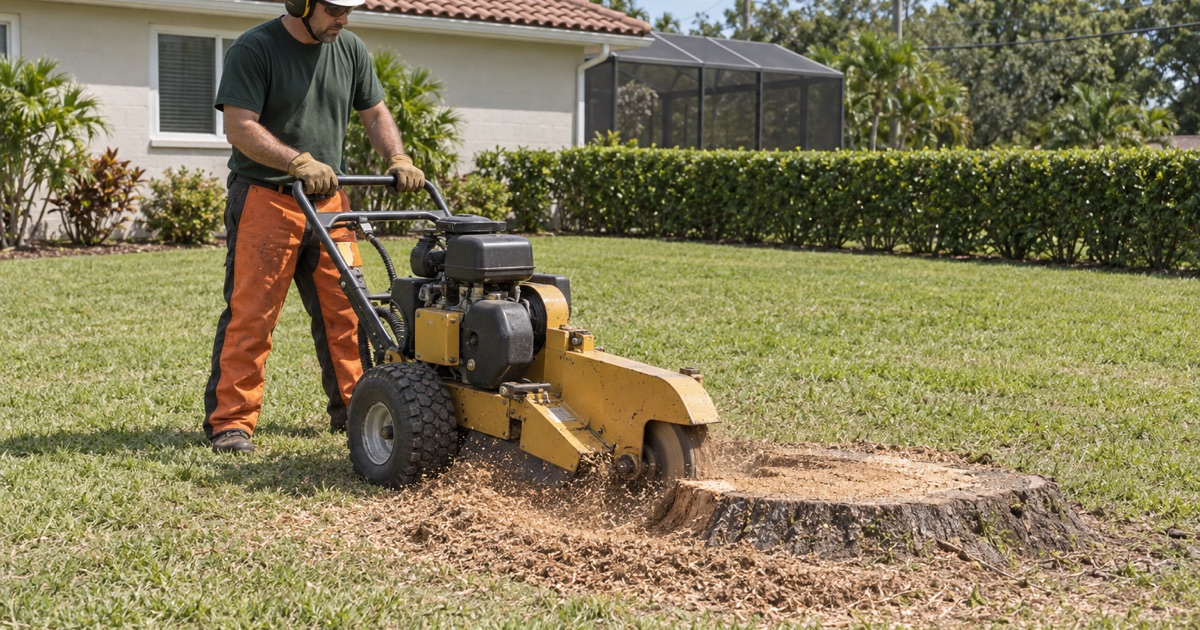
In the EauGallie series the spodic Bh horizon typically starts around 22 inches down and can run anywhere from a couple of inches to a few feet thick. That is the practical floor for stump work here. A grinder rated to 20 inches or less will usually stop above the hardpan; one rated to 25 inches reaches or enters it and works considerably harder doing so. We tell you which of those your job is before the machine is booked.
A Water Table That Moves With the Season
These are poorly drained soils where the seasonal high water table rises within 6 to 18 inches of the surface for part of most years and stays within 40 inches for much of it. Wet ground changes the job twice over: the grindings come out heavy and slump rather than mounding, and a tracked machine can mark or rut turf that would carry it in April. Scheduling around that is often free, and we raise it rather than waiting for you to notice.
Matching the Cut to What Comes Next
Grinding for Sod, Beds and Level Ground
If the plan is turf or a planting bed, a modest below-grade cut is genuinely sufficient and paying for more is paying for nothing. The work that matters at this depth is lateral rather than vertical: chasing the surface roots radiating from the flare far enough out that nothing telegraphs through new sod as it knits. We grind the flare wide, backfill with the arisings and rake it flat.
Grinding for Slabs, Posts, Footings and Replanting
Structural work is a different specification and a different price. A fence post, a footing, a shed pad or a slab needs the wood out of the bearing zone entirely, and a replacement tree needs undisturbed ground for its root ball rather than a bowl of decomposing chips. Both mean a deeper cut, a wider radius and grindings hauled away instead of backfilled. Say what is going in and the quote is written for it.
Surface Roots and the Radius Around the Stump
The stump is rarely the whole complaint. Buttress roots lifting a walkway, a driveway edge or a paver run are their own line of work, and grinding them out has limits worth stating plainly: cutting a major structural root on a tree that is staying is a stability decision, not a cosmetic one. Where the tree is going anyway, the radius is a free choice; where it is not, we say what the root is holding up.
Access, Machines and Protecting the Property
Narrow-Gate Machines for Fenced and Screened Yards
Access sets the machine, and the machine sets the depth. A narrow-gate grinder passes most standard side gates and screen enclosure doors, which is what makes back-yard and pool-cage stumps possible at all, and it cuts shallower and slower than the equipment that works an open front yard. Where a stump sits behind a fixed enclosure, we quote the access constraint openly rather than discovering it on the day.
Irrigation, Utilities, Septic and Seawalls
Before a wheel turns we locate irrigation lines, low-voltage lighting, invisible fencing, septic tanks and drain fields, and confirm utility locates where the depth warrants it. Grinding blind into a drain field is expensive in a way no stump is. On waterfront lots the seawall tie-backs behind a bulkhead are a further reason to know where the machine may and may not cut.
Multi-Stump Jobs, Common Areas and Commercial Lots
Associations, community development districts, property managers and commercial owners usually have a list rather than a stump. Those jobs get mapped and priced per stump with the access constraint noted against each, so a board can see why the four in the retention easement cost what they do and the six along the parking row do not. Mobilization gets shared across the list rather than charged against each line.
Grindings, Backfill and Disposal
What We Do With the Arisings
Backfilling the hole with its own grindings and raking level is the default and is included. It settles over a few months and occasionally wants a top-up, which is worth knowing before you lay sod the same week. Some owners want the arisings spread as mulch on beds elsewhere on the property, which is free and works well as long as it is not piled against a trunk.
Clean Fill, Sod and a Finished Surface
Where the ground has to be finished properly — a lawn that will be looked at, ground being handed over to a builder, a common area a board is paying to look tidy — the grindings come out, clean fill goes in and sod goes over it. That is three separate costs and we name them separately, because the difference between a raked mound and a finished lawn is exactly where stump quotes tend to hide their variation.
Hauled Loads, Gate Rates and Palm Removals
Grindings that leave the property are weighed at a permitted facility like any other load, and the rates are public: Manatee County’s Lena Road Landfill posts yard waste by the ton with a minimum charge, penalizes mixed and uncovered loads, and charges material originating outside the county at triple rate. Palm stumps deserve their own note here — fibrous, water-holding and heavy — and where the palm came down with a Ganoderma conk at its base, the stump and root mass come out with it.
- 20+ Years on This Coast
- Written Estimates
- No Topping, No Hat Racking