Bradenton Tree Removal offers crane assisted tree removal for the jobs where conventional felling and rigging are the wrong tools. Two decades of removals on this coast is what tells us which of those jobs is which, and the honest version of this page starts by saying that most removals do not need a crane at all — the ones that do are usually obvious for one of two reasons, and both are about access or structure rather than size.
The first reason is that there is nowhere for the wood to go. Screen enclosures, pool cages, lanais, courtyards, seawalls and tightly spaced waterfront lots are common here, and they produce trees with no usable drop zone in any direction. The second is that the tree itself cannot be trusted to hold a climber or take rigging loads.
A crane is quoted the way everything else on this site is quoted: in writing, with the machine time, the crew, the disposal and any traffic control named as their own lines rather than folded into a single number.
When a Crane Is the Right Call
No Drop Zone and No Rigging Point
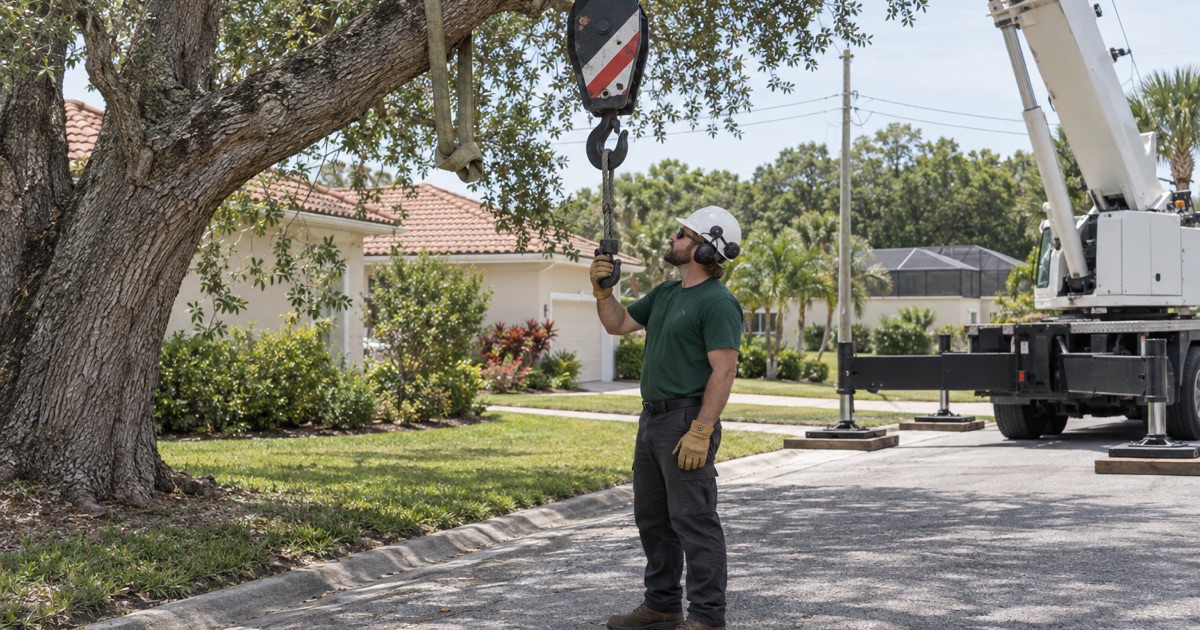
Conventional removal needs somewhere to put sections and something sound above them to lower from. Take away either and the job stops being a felling problem and becomes a lifting problem. A tree growing tight against a house with a pool on one side and a fence on the other has no answer in the conventional toolkit that does not involve hundreds of small pieces carried by hand.
Screen Enclosures, Pool Cages and Courtyards
These are the structures that make crane work routine here rather than exceptional. A screen enclosure fails progressively and expensively under even modest impact, and repairing a bent frame often means replacing a whole run of it. Lifting sections clear of the enclosure entirely removes the risk rather than managing it, which is usually cheaper than the deductible on the repair.
Trees Nobody Should Be Climbing
The structural case is the one that matters most. A trunk with advanced internal decay, a palm with a Ganoderma conk at the base, a storm-damaged tree with a partly torn union, or a stem with a long vertical crack cannot be relied on to hold a climber or absorb rigging loads. A crane lets the work happen without anybody being in the tree while it is under load.
What a Crane Job Actually Involves
Setup, Outriggers and Ground Bearing
The setup decides everything. Outriggers need firm, level ground with the load properly spread, and in these soils that is a real consideration rather than a formality — soft verges, recently filled ground, septic tanks, drain fields, shallow utilities and seawall tie-backs are all reasons a spot that looks fine will not carry the machine. We identify the setup pad on the site visit, not on the morning of the lift.
Access, Neighbors and Traffic
The truck has to get in, and the boom has to swing between the setup point and the tree without fouling anything. On narrow residential streets, gated communities and waterfront lots that frequently means arranging road access, traffic control or a neighbor’s permission ahead of time. All of that is organized before the date is confirmed, and any agreement involving somebody else’s property is put in writing.
Load Planning and the Order of Picks
Each pick is planned before it happens: where the sling goes, roughly what the section weighs, how the tree will behave as weight comes off it, and where the piece is going to land. The order matters because removing weight changes the balance of what is left, particularly on a leaning or one-sided tree. Working near energized conductors adds hard clearance limits that the plan has to respect regardless of convenience.
Cost, Alternatives and Straight Advice
Why a Crane Sometimes Costs Less
The hourly rate is higher and the total is often lower. Sections come out whole and go straight to the chipper or the truck, which removes the slowest part of a confined-site removal — cutting material small enough to carry and then carrying it across a lawn. On a tight lot that difference can be two days of labor, and on a property with delicate turf or pavers it also removes most of the damage risk.
When We Talk You Out of One
Plenty of trees that look like crane jobs are not. An open front yard with a clear drop zone rarely justifies one whatever the tree’s size, and a tree that is sound enough to climb with room to rig is usually cheaper worked conventionally. We quote the option we would choose ourselves and explain the reasoning, including the times that means a smaller invoice than the one you were expecting.
What Still Has to Happen Afterwards
A crane removes the tree; it does not finish the job. The stump, the grindings, the disposal weight and any repair to turf, pavers or irrigation from the setup are separate items with separate costs, and they belong on the estimate where you can see them. On a palm taken down for disease, grinding the stump and root mass out is part of the scope rather than a later conversation.
- 20+ Years on This Coast
- Written Estimates
- No Topping, No Hat Racking