Bradenton Tree Removal carries out invasive tree removal and exotic species clearing across Bradenton and the surrounding counties. This is a different kind of job from most tree work, and the difference is worth stating up front: on a great many of these sites the removal is not the owner’s choice. It is a condition in a code, a development approval or a site plan, with an inspection at the end of it.
That changes what the service has to deliver. Cutting the stems down is the easy part and, for several of these species, the part that accomplishes least. What makes the work stand up is the treatment that stops the resprout and the record that shows what was done and when.
Twenty-plus years working parcels across four counties is what keeps this straightforward, because the species lists and the exemptions are not identical from one jurisdiction to the next and neither is what a reviewer expects to see afterwards.
The Species That Keep Appearing
Brazilian Pepper
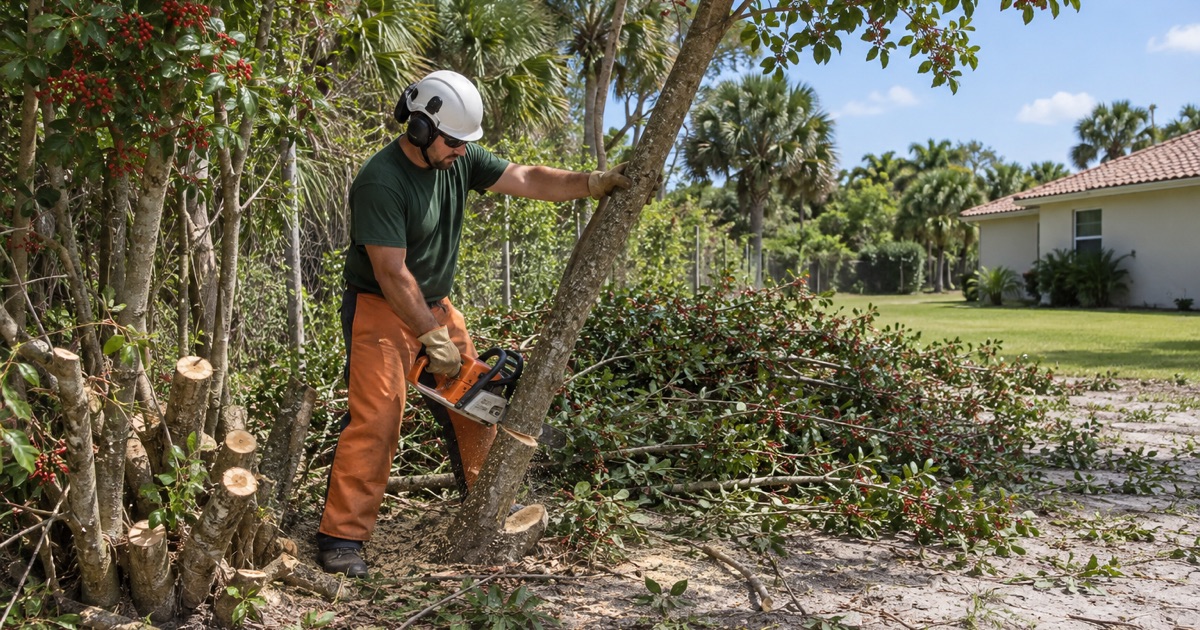
Brazilian pepper is the one we clear most. It forms dense thickets that shade out everything beneath, spreads readily from seed carried by birds, and resprouts strongly from cut stumps, which is why mechanical clearing alone reliably fails. Removal here means cutting, treating the cut surfaces promptly, and returning to deal with what comes back, rather than one visit with a machine.
Australian Pine and Melaleuca
Both are large, fast and problematic in different ways. Australian pine is shallow-rooted for its height and comes down readily in wind, dropping a great deal of material at once, and it acidifies and shades the ground beneath so heavily that little else persists. Melaleuca is exceptionally difficult to eradicate once established, because disturbance itself triggers mass seed release — so how it is felled matters as much as that it is felled.
Earleaf Acacia and the Rest of the List
Earleaf acacia rounds out the group that turns up most often on approvals here, and there are others depending on the parcel and the code. What they share is the reason they are named: they establish quickly on disturbed ground, they displace what was there, and they persist through anything short of a deliberate treatment plan. We identify what is actually on the site rather than clearing to a generic list.
Removal That Holds
Cut-Stump Treatment and Timing
For the resprouting species the treatment window is short — cut surfaces are receptive for a limited period after the cut, and a stump treated the following week is a stump that will resprout. So the treatment happens as part of the cutting rather than as a separate mobilization, and the products and rates are matched to the species and to whatever is nearby, which on a shoreline or a wetland edge constrains what may be used at all.
Mechanical Clearing and Mulching
On a dense stand, running a mulching head through it is usually faster and cheaper than felling and hauling, and it leaves nothing to weigh at a disposal gate. It also leaves the root systems, so on species that resprout it is a first pass rather than a finish. Where a building pad or a drainage structure is going in, grubbing and hauling is the correct scope and we price it as that.
The Follow-Up Visit
Almost every invasive removal here needs at least one return. New growth from missed stumps, seedlings germinating in the light the clearing created, and root suckers all appear within the first season. Building that visit into the scope rather than selling it later is what makes the difference between a site that passes its inspection and a site that has to be cleared twice.
Compliance, Jurisdiction and Records
When Removal Is a Condition Rather Than a Choice
A great deal of this work arrives through a paper trail: a code provision, a plan review comment, an approval condition, or a management plan for a preserve or a conservation area. In those cases the specification is written down, including which species, over what area, and to what standard. We work to that document rather than to a general practice, because the party who signs off is reading it.
Exemptions Cut Both Ways
Local codes commonly exempt listed exotic and invasive species from the tree permit, which is one of the few places where the rules make this work easier — Sarasota County’s own exemptions reach species on the Florida Exotic Pest Plant Council list, for instance. That exemption is about the species, not about the location, so a shoreline, a wetland, a mangrove fringe or a conservation easement still carries its own separate jurisdiction whatever is growing there.
The Record We Leave
Every compliance removal leaves a written record: species, area, method, treatment date and product class, and photographs before and after. That record is the deliverable as much as the cleared ground is, because it is what an inspector, a reviewer, a board or a future owner reads. It cannot be reconstructed later, so it is written as the work is done.
- 20+ Years on This Coast
- Written Estimates
- No Topping, No Hat Racking